Showing posts with label Lia de Thornegge. Show all posts

Thursday, 8 April 2010

Coat of Arms project - Shire of Aros badge finished


I sent out a message on our mailing list saying I had finished the badge I promised to do, namely for the Shire of Aros, and there I promised pictures. Here is the promised picture, showing how I outlined the entire badge in chain stitch, the owl separately in chain stitch in black, then on the outside again with chain stitch, and the surfaces finally filled in using split stitch.

The laurel wreath is not that pretty, or even, but I used stem stitches and satin stitches to make it up. From the right distance it looks like a wreath at least, which is what counts.

There are three more pictures in my Giftbasket gallery on Picasa for anyone interested.

/Lia

Sunday, 13 September 2009

Scarletworked coif action shot

An update, I found at least one decent picture of Helwig wearing the coif and forehead cloth at Midsummer coronation in Edricus' album from the event. Check it out here.

Monday, 7 September 2009

Scarletworked coif

Hello fellow embroiderers.

This summer I worked on a small project of embroidery for my Laurel, Helwig Ulfsdotter. I made a forehead cloth and coif set for her elevation. I took the pattern for the coif from Janet Arnold's Patterns of Fashion 4, and the forehead cloth that goes with this coif has the same dimensions as many extant forehead cloths kept at the Boston Museum of Fine arts (roughly 40 cm x 20 cm).

The embroidery pattern is taken from an extant coif, found via Christie's auction site. The thread used is Splendor silk. It comes as 12 ply, and I used two threads, so each length of thread went a long way. It was fantastic to work with. I used stem stitch throughout the embroidery. I think the result was well worth the effort put in, and I can't wait to make myself a matching set of forehead cloth and coif.

Unfortunately I have no good photos of Mistress Helwig wearing the set. I'll try to get one though.

Thursday, 8 May 2008

Embroidery - a winning concept.

Hello all, it's been a while since my last entry, mostly because I have not done any new embroidery. However, I thought I should post a report on a success I had at Double Wars.

Meisterinne Katheryn asked me in the middle of the week to enter the A&S competition with my apron, which I had out at the time to show off, and I agreed. My documentation was not exhaustive or very long, so I quote it here:

ITEM: Embroidery, 16th Century on an apron. PLACE: Italy.
Documentation:
The embroidey on this apron is done in madder dyed silk thread on linen. The pattern is taken from the facsimile of a 1561 pattern book by Giovanni Ostavus(*) and the stitch is long-armed cross stitch(**) which was commonly used in the period(#).
This kind of counted embroidery was commonly applied to aprons, shift, smocks and shirts. Black and red were the most common colours, being very effectful against white linen. Queen Elizabeth's Wardrobe Unlockd lists an apron with "carnacion in graine silke"(##) - being a red colour. In Moda a Firenze a photo fo a detail of a painting by Alessandro Allori shows an apron with embroidery done in black(¤).

* La vera perfezione del disegno di Giovanni Ostavus, 1561. Available on-line at the University of Arizona.
**, # Embroideries at Hardwick Hall, a catalogue. Levey, Santina M.
(Stitch diagram drawing here).
## Queen Elizabeth's Wardrobe Unlockd. Arnold, Janed. Page 225.
¤ Moda a Firenze. Orsina Landini, Roberta & Niccoli, Bruna. Page 130.
I had no expectations, so when they called my name in court as the winner of the competition it was a complete surprise. But there you go, embroidery can be a winning concept. :)

Saturday, 6 October 2007

Apron embroidery

Hello all,

I've been busy again, working on an apron for myself. It is a very basic rectangle, and white, and I thought it was a little boring so I wanted to do some rows of embroidery near the bottom of it in either drawn thread technique, or assissi cross stitch technique in the planning stage.

Going beyond planning, I went to the On-Line Digital Archive of Documents on Weaving and Related Topics, particularly the Italian listing, where I knew a number of period pattern books were to be found. In the pattern book published in 1561 by Giovanni Ostaus I found what I was looking for, a pattern that would look good done in a cross stitch along the bottom of my apron.

I have not gotten very far, as yet, but I did complete the first row in time for Nordmark's Civil War event. The stitch I am using is called long-armed cross stitch, (simple stitch diagram) or tvistsom stitch (tvistsöm in Swedish). In period it was often used to entirely cover a surface, to make pillow covers and such items, but it was also common to find bands of red work embroidered with this technique. The thread I had at hand was a skein of madder dyed silk, given to me in January this year. I did not know what to do with it until now - and it is a treat to work with. I only hope it lasts to the end of my pattern!

Well, enough preamble, I expect you'd like to see the progress I have made, and I can't wait to show it off to you all :) The image below is clickable, and will take you to my flickr site, where you can view a larger version of the photo. As yet I have done the first row, and started on the middle one. The top row will be the same height as the first one at an equal distance above the wider middle band.
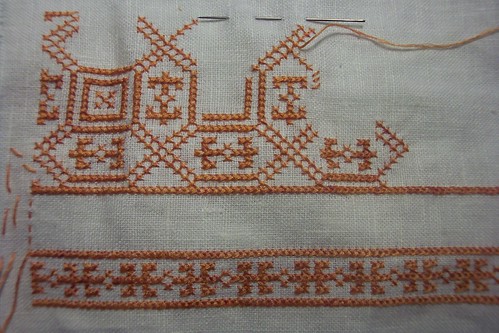
2nd Row of Apron Embroidery

So, what have you been working at?
/Lia de Thornegge

Saturday, 4 August 2007

Ingrid's blackworked collar and cuffs

Hello again. I finished the set of collar and cuffs that I was embroidering for my friend Ingrid, and I thought I should share the results here with you.

I am using a linen ground fabric which (by happy chance) is an even weave fabric. This is the best kind as it makes the geometric patterns nice and squared like they are supposed to be. The thread I've been using is Gütermans silk sewing thread, and each stitch is taken over two threads of my ground fabric. I am using Holbein stitch (also called double running stitch), which makes a single unbroken line in two passes of the running stitches. So the entire embroidery is reversible - save for a few less than perfect anchorings of my thread.

The pattern is one drafted by Viscountess Helwig Ulfsdotter from a photo in Queen Elizabeth's Wardrobe Unlock'd which I had saved from one of her classes. As always there are adjustments to be made at the edges of the embroidery and for the collar I closed the two rows of embroidery up in as seamless a way as possible at either edge. Since the cuffs are made up of a single row of my pattern I let those ends curl back in on itself to prevent too much white space happening.

Finally, here are photos of the finished embroidery. (Click for large versions)
16th C Blackwork embroidery for Ingrid, collar and cuffs (July 2007)16th C Blackwork embroidery for Ingrid, collar and cuffs (July 2007)16th C Blackwork embroidery for Ingrid, collar and cuffs (July 2007)

Friday, 27 July 2007

Introduction

Greetings fellow Drachenwald embroiderers. I am Lady Lia de Thornegge, normally residing in the shire of Aros in Nordmark. Racaire enjoined us to introduce ourselves and our favourite stitch, so I am here to say I love counted blackwork embroidery using Holbein stitch making the entire thing reversible.

This stitch is worked using silk thread on even weave linen in geometric patterns. There are loads to be found on the 'net and more to be found in books, Queen Elizabeth's Wardrobe Unlock'd by Janet Arnold, being one of the latter. As that title suggests this is a stitch most famous in the Elizabethan era, where it creates a striking pattern with black on white for very little effort. I've made a few items of clothing incorporating blackwork embroidery and they can be seen on my webpage, along with a couple of other items: http://www.geocities.com/lia_de_thornegge/embroidery.html

I am currently working on a set of collar and cuffs that is due to go on a shirt of this period (mid to late 16th Century). I am not keeping it for myself, rather it is a little encouragement gift for a lady living in the middle of nowhere (as far as the SCA is concerned) whom I would like to see in late period clothing. I am crafty that way.